

If we had to summarize in on sentence what we, the partners of My Diversity, Our Strength, have learned and experienced through the project, it would be : innovation is never a straight line; it’s a continuous loop of creation and improvements. You will find in this article 4 key lessons that illustrate this idea.
Lesson 1: The power of co-creation
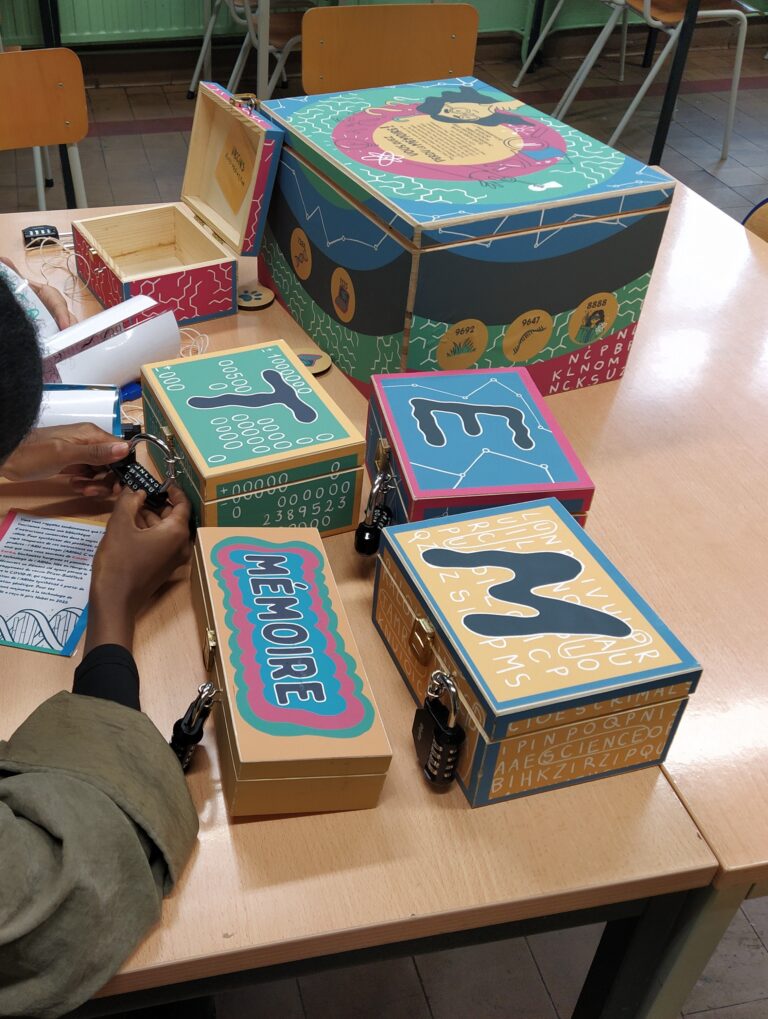
When we began developing the Escape Box, each partner had their own vision of what could be created. Hence the first step was to harmonize these visions through two online co-creation sessions. We have pooled our creativity and skills in our various areas of expertise. Together, we imagined the challenges, gathered our ideas by theme, and voted on what to keep and what was better left aside. Then graphic designers and carpenters brought the project to life when creating the prototype of the box. After some testing, each partner finally received the box in their own language. What a feeling to finally see hours of common work and research come to fruition in a unique educational tool, ready to be tested with young people! We would never have achieved such a result individually.
Lesson 2: The Essential Role of Testing
The prototype of the box was first tested with educators. Their reactions were very valuable. We carefully listened to their feedback and then adjusted certain elements of the activity. We got their insight on what truly fostered collaboration, what caused confusion, and how the inclusion themes were perceived. Each testing cycle allowed us to refine the structure: adjust the timing, clarify the narrative, simplify certain tasks… Through this process, we gained perspective on our own creation. We also learned to understand the mechanisms behind creating an effective educational escape game. And more than a product of imagination, an educational escape game must above all meet the needs of the target audience. That is why we also organized testing sessions with youth. Involving end users from the earliest phases was key to create a meaningful and effective tool.
Lesson 3: What the Results Tell Us – Game-Based Learning is an effective approach to Help Fight Gender Stereotypes and Empower Youth in STEM
Testing the Escape Box brought us encouraging results that confirmed the relevance of My Diversity, Our Strength and its objectives.
Overall participant satisfaction was very high. The vast majority of both girls and boys found the activity engaging, the puzzles stimulating, and the main theme interesting.
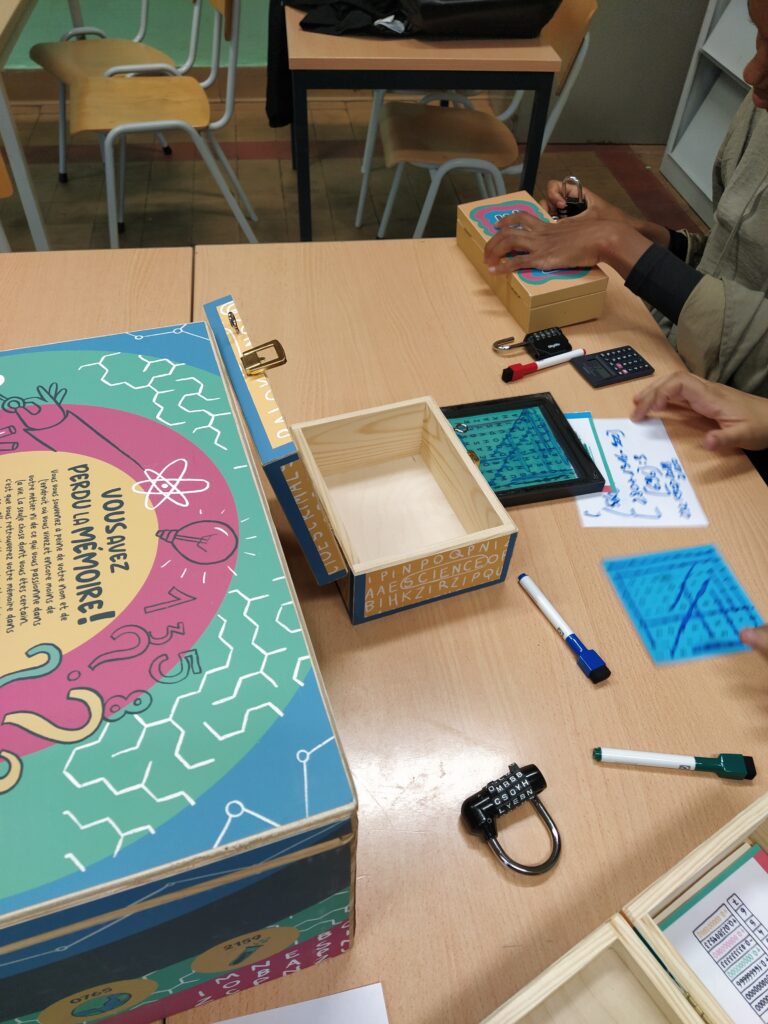
Young people particularly appreciated the hands-on manipulation around the science puzzles. One participant stated: ” Instead of just reading about science in a book, we had to use our hands to find clues and open padlocks. It made the learning process feel much more active and exciting than a normal lesson.”
Teamwork was also highlighted as a major strength: “Because we all have different strengths, we were able to help each other when a puzzle was too difficult. It was rewarding to see how our combined efforts led us to the correct codes.”
But beyond engagement and enjoyment, we observed, through pre- and post-activity questionnaires, an evolution in their perception of STEM and the place of women in science.
This happened in two ways. First, through the content itself. Participants had the opportunity to discover great figures in science as well as STEM content in a fun way. One participant confided: “The game showed me that history hides women scientists. […] Now I see that STEM isn’t just a ‘boys’ club’.”
The second angle is the creation of a supportive environment in which a mixed group collaborates to achieve a common goal. An environment where mistakes are no longer shameful. And that’s where perceptions shift. One participant said: “I always thought that scientists had to be ‘perfect.’ Even though we struggled with the puzzles, the story showed that science is about perseverance, not just getting the right answer immediately.”
This is exactly what we hoped for: to transform the perception of STEM fields by creating an environment where mistakes become a natural step toward the solution rather than a source of shame, and where the diversity of scientific profiles becomes an asset.
Possible Improvements and Future Perspectives
Lesson 4: Accessibility and inclusion are at the heart of the activity, but it remains an ongoing work
Part of the testing was conducted with young people with learning disabilities (dyslexia, dyscalculia, dyspraxia). Their feedback and the one of their therapists allowed us to identify different axes for future improvement of the box, for it to be even more inclusive.
The speech therapists who facilitated the activity highlighted a delicate balance: even if some of the tasks were challenging for them, the storyline kept them motivated. They tackled reading and math problems they would normally have avoided in a traditional classroom.
Nonetheless, they also suggested several possible adaptations such as enlarging the stickers that are manipulated, adding 3D tactile symbols, or offering audio versions of texts and/or series of icons (to explain the steps of the story). These elements could help reduce cognitive load under time pressure and are fairly simple improvements to implement, keeping in mind that greater accessibility can always improve the experience for all participants.
More generally, we see the Escape Box as an evolving tool that anyone can take ownership of. We can therefore imagine various evolutions and adaptations:
- Creating specialized versions focused on a particular scientific subject, making their use easier for high school teachers in classrooms
- Integrating technological objects and/or physics-chemistry experiments in the form of playful practical work
- Adapting the difficulty level for different audiences and educational contexts (this version works very well with 16-18 year old young adults).
- Some participants also suggested further developing the narrative immersion (developing the causes of the main character’s amnesia ; creating a complete story around the protagonist’s profession…) or creating a larger box with more puzzles
So now, it is your turn! The real value of this Escape Box lies in its adaptability. The idea is for YOU to take ownership of it, reshape it and make it your own, according to your needs, your audience and your context. All the materials and detailed instructions are available on the project website and will remain accessible for at least five years.
Each new version can build on the lessons learned throughout My Diversity Our Strength: grounding activities in real needs, working collaboratively and using games as a powerful driver for inclusion. This is how, step by step, invisible barriers can be broken down.
We invite you to test the Escape Box, adapt it and share your experiences with us. Because ultimately, this is not the end of My Diversity Our Strength, but the beginning of an ongoing, collective reflection on inclusive education and equality.

